
Marketing Agency for Startups: In-House vs Agency

Summary
Should you hire a marketing agency or build an in-house marketing team? If you are a startup founder, this question probably comes up every time you think about growth. And it should. Marketing is how your company gets in front of buyers, wins new customers, earns referrals, and builds the reputation that makes competitors irrelevant.
The team responsible for marketing shapes how the market sees your business. Get it wrong, and you lose time, money, and momentum at the stage where you can least afford it.
So, should you hire an agency or build in-house? That is how most founders frame it. But the question is incomplete. It only gives you two options when there is a third one most people overlook: a hybrid approach that blends strategic partnership with internal ownership. The better question is not which option is best. It is the combination that makes sense for where your company is right now, and how it should evolve as you grow.
We wrote this article to give startup founders and CEOs a practical way to think through their marketing and how to connect with the market. Here is what we cover:
Why the agency vs. in-house debate is flawed and the better question that actually drives growth
Why choosing between agency, in-house, or hybrid is harder for startups
What you should keep inside and what to delegate, without losing momentum
A 4-step approach to align your marketing with how your company actually grows
The real cost of hiring vs. partnering (and why salary vs. retainer is the wrong comparison)
Exactly when to hire in-house, bring in an agency, or use a hybrid approach, and how to get it right
A practical decision resource for founders building a marketing engine aligned to revenue targets, growth milestones, and long-term impact.
Why the agency vs. in-house debate is flawed, and the better question that actually drives growth
Here is a question we hear from startup founders almost every week: Should I hire a marketing agency or build an in-house marketing team?
It is a fair question. But it is also incomplete.
Why? Because it frames the decision as a either/or choice. Agency or in-house. External or internal. One or the other. And that framing hides the real issue.
Here is the issue: marketing is not just about running campaigns or generating leads. It is how you get your company in front of buyers, keep customers coming back, and collect the intelligence from the market that helps you refine your product, sharpen your positioning, and understand what actually drives someone to buy. The team responsible for the marketing function shapes how the market perceives your company. They influence your positioning, your messaging, and the story prospects hear before they ever talk to your sales team.
That is why choosing who handles marketing carries so much weight. It is not a staffing question. It is a growth question. And the answer depends entirely on where your company is right now.
A startup doing $500K in revenue is in a completely different situation than one doing $8M. The founder at $500K is still figuring out who the ideal customer is and what message makes them lean forward. The founder at $8M already knows that and now needs volume, speed, and specialization. Asking both founders the same question, agency or in-house, is like asking someone whether they need a car or a bicycle before they have told you where they are going. The marketing commitment depends on your company's revenue, the traction you have earned, and what your business actually needs to grow right now.
Meanwhile, the hiring math keeps getting harder. According to the Bureau of Labor Statistics, the median annual salary for a marketing manager is now $161,030. That is before benefits, recruiting costs, tools, and onboarding. For a startup spending 8% of its revenue on marketing (the median benchmark from SaaS Capital's 2025 survey), the entire marketing budget at $2M in annual revenue is $160,000. That does not even cover one fully loaded hire.
So what should founders actually be asking?
Not agency or in-house. The question is: what should stay close to the founder, what can a strategic partner help co-pilot, and what can be outsourced for specialized execution, given where we are right now?
From our perspective at Xzito, the answer for most companies generating under $10M is a hybrid approach. Not hiring one generalist and hoping for the best. Not outsourcing everything to a vendor who does not understand your business. Instead, partnering with a team that brings a fractional growth strategist to co-pilot the marketing function alongside the founder, combined with subject matter experts who can build the brand, develop the infrastructure, generate leads, and fuel the growth engine.
That is the core of our Revenue Growth Program: a fractional team player who helps structure and build, bringing the best subject matter experts to develop a program that grows your brand, gains market intelligence, generates pipeline, engages customers, and ultimately helps you scale your business. The founder stays connected to the strategic decisions. The partner brings the expertise and execution capacity that the founder cannot build alone.
As your company crosses the $10M mark, the model evolves. You bring more capabilities in-house, hire your own CMO, and build an internal team. And the agency relationship shifts from strategic partner to specialized execution partner.
That is the approach we are going to break down in this article. Let us start with why choosing who handles marketing is uniquely hard for startups.
Why choosing between agency, in-house, or hybrid is harder for startups
When a Fortune 500 company needs marketing help, the situation is relatively straightforward. They have a brand that people recognize. They have customers and years of data showing what works and what does not. They can run many of experiments simultaneously, or test a quick new technique on a Tuesday afternoon without betting the company on it. They have the infrastructure and the budget to absorb the risk.
Startups do not have any of that.
A startup in its first few years is operating under a completely different set of conditions. The product is still evolving. The market has not fully validated the offer. The ideal customer profile is a hypothesis, not a fact. And every dollar spent on marketing is a dollar that is not going toward product development, hiring, or extending the runway.
Startups are constantly experimenting. The product is changing. The messaging is evolving. The customer profile gets sharper every month. Every marketing decision has to account for this reality.
And there is a more fundamental question most founders avoid: can you even afford a full-time marketing team right now? For most startups under $3M, the answer is no. The math does not support it. Which means the decision is not just strategic, it is financial. You need a way to get real marketing capability without the overhead of a team you cannot yet sustain.
A campaign that worked last quarter might be irrelevant this quarter because the product changed, or the positioning shifted, or a new competitor showed up. Unlike an established company that can absorb a failed experiment, a startup might only get a few shots before the budget runs out. The marketing approach has to be lean enough to experiment, flexible enough to pivot, and structured enough to learn from every test.
This is why we believe the right approach for most startups under $10M is not choosing between agency or in-house. It is to design a program around three questions: What are the lead generation goals? What brand assets need to be built? How much fuel is needed to drive the growth you are capable of? Once you answer those, you can design the right combination of internal ownership and external partnership, and that combination will evolve as your revenue grows.
With that context, let us establish the principle that should guide every marketing decision at a startup.
What you should keep close and what to delegate without losing momentum
Never outsource the things that teach you about your customer.
This is the principle most comparison articles miss entirely. They will tell you to outsource "creative" and keep "strategy" in-house, as if those are neat, separable categories. They are not.
In the early days of a startup, the most valuable marketing activity is learning. Learning who your customer really is. Learning what language resonates with them. Learning what objection kills the deal. Learning what story makes someone say, "Tell me more."
That learning has to stay close to the founder. Not because the founder is the best marketer. Often they are not. But because the insights from that learning shape everything: the product roadmap, the pricing, the positioning, the entire go-to-market motion.
As our CEO Jeshua Zapata learned during his time at MIT, this principle is non-negotiable in the early days: you cannot outsource the customer learning. The founder needs to have those conversations directly. User interviews, assumption testing, figuring out which beachhead market is actually willing to buy. You might discover submarkets you never expected. You might realize your first customer profile was wrong. That intelligence is foundational, and it can only come from direct contact.
The misconception is that the founder has to do everything alone until they can afford a full-time hire. That is not true. What the founder actually needs, especially before $10M in revenue, is a strategic thinking partner. Someone who can facilitate the process, help structure the go-to-market, and bring independent perspective to the table. An agency partner like Xzito that operates as an extension of the leadership team, not as a vendor executing tasks in a silo.
The founder still stays deeply connected to customer insight, positioning, and go-to-market decisions. But they do not have to reinvent the wheel on how to build a marketing engine. That is the role of the partner. Here is a practical way to think about it:
Keep close to the founder and the internal team:
Customer insight and feedback loops: the conversations that shape your product and messaging
Positioning and narrative: the story of what you do, for whom, and why it matters
Founder voice and thought leadership: the credibility only you can build
Go-to-market decisions: which channels, which segments, which bets to make
Sales enablement: understanding exactly what converts and why
Bring in a strategic partner to co-pilot:
Growth strategy and planning: quarterly roadmaps, scorecards, and revenue alignment
Marketing infrastructure: CRM setup, automation, analytics, and tech stack configuration
Brand development: translating the founder's vision into a consistent market identity
Channel strategy: which platforms, which content formats, which campaigns to test first
Outsource for specialized execution:
Technical SEO: site speed, crawlability, schema markup
Paid media management: campaign setup, bid management, creative testing
Campaign production: email sequences, landing pages, design assets
Content operations: blog production, social scheduling, distribution workflows
The principle is straightforward: if a task teaches you something about your customer or your market, stay connected to it. If it requires a strategic approach you do not have yet, bring in a thinking partner. If it is specialist execution that requires deep technical skill, outsource it.
This three-part approach is what separates startups that scale their marketing intelligently from those that either try to do everything themselves or throw money at vendors and wonder why nothing sticks.
Now, let us look at how this evolves as your company moves through different revenue milestones.
A 4-step approach to align your marketing with how your company actually grows
Your marketing should not be static. It should evolve as your company moves through distinct milestones. What works before product-market fit is fundamentally different from what works once you have a repeatable pipeline.
Here is the approach we use with our clients, broken into four steps:
Step 1: Pre-Product-Market Fit ($0 - $500K ARR)
Team size: Founders + a few early hires
Marketing approach: Founder-led, with a strategic advisor or fractional partner to co-pilot
At this point, you are not marketing. You are learning.
Everything about your business is a hypothesis. Your ideal customer profile is a guess. Your messaging is a draft. Your pricing is an experiment. The only way to validate any of it is through direct contact with prospective customers: conversations, demos, sales calls, and user interviews.
The founder needs to be in the trenches at this point, talking to potential customers, testing assumptions, and finding out if anyone actually needs what you have built. But this is also where the right strategic partner makes the biggest difference. Not someone running campaigns for you. Someone who helps you structure your go-to-market thinking, identify your beachhead market, and turn raw customer conversations into a real marketing foundation, so that every conversation you have as a founder is more focused, more strategic, and more likely to turn into traction.
What you might outsource: A basic website build. A logo and brand identity sprint. Initial analytics setup. Advisory from someone who has helped other startups navigate this point in their growth.
What should stay with the founder: Customer conversations, positioning, messaging, beachhead market selection, and every insight that comes from direct user interviews. This is the foundation everything else gets built on.
Step 2: Early Traction ($500K - $2M ARR)
Team size: 10-25 people
Marketing approach: First marketing hire or fractional CMO + selective agency support
You have customers. They are paying. Some of them are renewing. You are starting to see patterns in who buys and why.
This is the inflection point where most startups make their first marketing mistake: they either hire too senior (a VP of Marketing who is used to managing teams, not doing the work) or too junior (a social media coordinator who cannot think strategically).
First Round Capital's research on startup marketing hires is useful here. They separate the marketing hire into distinct roles depending on what the company needs: a product marketer to nail positioning, a growth marketer to build repeatable acquisition, or a brand marketer to build awareness. The mistake is treating "marketing" as one function and expecting one person to cover it all.
At this point, the best approach for most startups is either one strong internal marketing generalist or a fractional CMO who can own the strategy, manage the messaging, and serve as the connective tissue between the product and the market. Pair that person with agency or freelance support for the specialized execution they cannot handle alone.
This is where a strategic agency partnership starts to make real sense. You have enough traction to know what to say, but not enough headcount to say it everywhere. This is the exact point where many of our clients at Xzito first engage with us. They bring the customer knowledge and ambition. We bring the strategic thinking, the marketing infrastructure, and the specialized execution to turn traction into a repeatable growth system.
What you might outsource: Website redesign, content production, paid media management, email setup, and technical SEO.
What should stay close to the founder: The founder still needs to be deeply connected to positioning, ICP validation, and anything related to the sales conversation. But a strategic partner can help facilitate and accelerate these decisions. The key is co-strategizing, not delegating the thinking entirely.
Step 3: Repeatable Pipeline ($2M - $10M ARR)
Team size: 25-75 people
Marketing approach: Small internal marketing team + strategic agency partnership
Now we are in real territory. You have channels that produce leads. You have a sales process that converts them. You know your ICP and your positioning is stable enough to scale.
This is where the marketing approach shifts. In the earlier steps, you kept most decisions close because you were learning. Now, you keep strategy and ownership internal, but you start outsourcing more execution because you need volume, speed, and specialization that a small team cannot provide on its own.
This is also where the right agency partner becomes critical. You are not looking for a vendor who runs your Google Ads. You are looking for a strategic partner who understands your revenue engine and can help you design, build, and fuel it.
The difference between a vendor and a partner is enormous. A vendor executes tasks. A partner connects the dots between your brand, your website, your content, your ads, your sales process, and your tech stack. They think about how each lever affects the others. They measure outcomes, not activities.
One of our clients, a B2B manufacturer doing about $1.8M when they first came to Xzito, is a good example. They had one marketing generalist internally but no strategic direction, no integrated tech stack, and no repeatable lead generation system. Through our Revenue Growth Program, we came in as their strategic partner: rebuilt their website into a conversion engine (RevSites), deployed and configured their CRM properly (RevTech), developed their brand positioning (RevBrand), and launched a paid media engine that generated measurable pipeline (RevAds). Within 18 months they had crossed $4M and had a clear, integrated marketing system they could continue to build on. That is what a strategic partnership looks like when it is connected to revenue, not just activity.
What you might outsource: Paid media at scale, content marketing operations, website optimization, marketing technology deployment, analytics infrastructure, and brand refinement.
What should stay internal: Revenue strategy, quarterly planning, sales alignment, and the decision of which bets to place. The agency should inform and challenge those decisions. The founder and internal team should make them.
Step 4: Scale Mode ($10M+ ARR)
Team size: 75+ people
Marketing approach: Full internal marketing team with agency specialists
At this point, you have the budget, the data, and the organizational complexity to justify a full in-house marketing operation. This is when you bring in your own CMO, build an internal team, and take ownership of the day-to-day marketing engine.
But even here, the smartest companies do not go fully in-house. They keep agency relationships for the specialized work that does not justify a full-time hire: high-end creative campaigns, advanced technical SEO audits, platform-specific advertising expertise, or strategic advisory that provides the independent perspective a CEO needs.
When we work with companies at this level through Xzito's Revenue Growth Program, the relationship looks different from what we do with earlier-revenue clients. At this level, we function as a specialized execution partner: deep expertise in paid media (RevAds), advanced web development (RevSites), marketing technology optimization (RevTech), or content strategy (RevContent) that complements an already-established internal team. The internal CMO runs the show. We bring the precision tools they cannot justify hiring for full-time.
The approach at scale is not "in-house instead of agency." It is "in-house as the engine, with agency specialists as precision tools."
The real cost of hiring vs. partnering (and why salary vs. retainer is the wrong comparison)
Every comparison article gives you the same math: a marketing manager costs X, an agency costs Y. But that calculation is incomplete because it only looks at salary vs. retainer.
Let us build a more honest picture of what a single in-house marketing hire actually costs a startup:
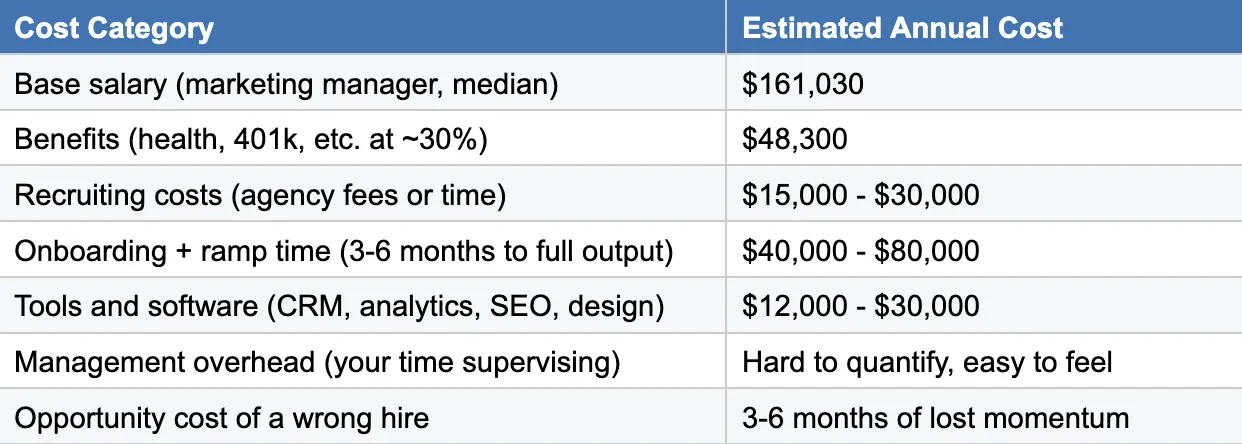
Add it up, and a single marketing hire can realistically cost a startup $250,000 to $330,000 in their first year. That is one person. And that one person is expected to do strategy, content, SEO, paid media, email, analytics, and brand management. That is not realistic.
Now compare that to a strategic agency partnership. At roughly $8,000 to $25,000 per month ($96,000 to $300,000 annually), you are not getting one person. You are getting a team that includes fractional subject matter experts across strategy, design, development, media buying, and content production. You are also getting a proven approach and a strategic partner who has helped other companies at your revenue level navigate the same challenges.
We saw this play out with a professional services company that came to us generating around $3M in revenue. They had tried two agencies before, both operating as vendors running disconnected campaigns. No shared strategy. No unified reporting. No one connecting their website, CRM, paid media, and sales process into a single system. Within six months of working together through our Revenue Growth Program, they had a fully integrated marketing engine, a CRM that actually told them where revenue was coming from, and a pipeline that grew 40% quarter over quarter. The difference was not budget. It was the approach.
For companies generating less than $10M, this approach almost always delivers more capability per dollar. For companies over $10M, the agency becomes more of a specialized execution partner that complements an in-house team.
The takeaway is not that agencies are cheaper. It is that the decision should be based on total capability at your current revenue level, not just a line item on a spreadsheet.
When to hire in-house, when to bring in an agency, and how to get the combination right
The right agency partnership, at the right point in your growth, can accelerate revenue faster than any single hire. Here are the signals that tell you the timing is right for a strategic partner:
You need an independent perspective and a proven growth approach. When you are inside your company every day, you stop seeing what an outsider sees immediately. A strategic partner brings pattern recognition from working across industries and revenue levels. They have seen what works, what fails, and what the data actually says.
You have traction but no bandwidth. Your ICP is clear. Your messaging is landing. Your sales team is converting leads. But you do not have enough content, enough campaigns, or enough presence to feed the machine.
You need specialist execution you cannot afford full-time. A great paid media strategist, a senior SEO consultant, a conversion-focused web developer. These are $120K to $180K hires individually. An agency gives you access to all of them for a fraction of the cost.
You need systems before headcount. Your CRM is disorganized. Your website does not convert. Your analytics do not track anything meaningful. You need infrastructure before you need more people.
The key word in all of this is partner, not vendor. A vendor runs your Google Ads. A partner helps you design your growth engine, connects every lever to revenue, and tells you the truth about what is working and what is not.
At Xzito, this is how we built our Revenue Growth Program. We work as a strategic partner that helps founders and CEOs design, build, and fuel a marketing engine matched to their revenue level.
For companies under $10M, we come in with quarterly strategy sessions (Strategy), build the brand and website infrastructure (Branding, Sites), deploy the right technology stack (Technology), and fuel growth through paid media and content (Paid Media, Content). We co-strategize with the founder while bringing the specialized skills and proven approaches they do not have internally yet. Over 20 years and 1,500+ client engagements, this approach has consistently outperformed both the "hire one person and hope" approach and the "outsource everything to a vendor" approach.
When building in-house becomes the right move
There comes a point where bringing capabilities in-house makes sense. Here is how to know you are ready:
Your messaging is stable and validated. You are not experimenting with positioning anymore. You know who you are, who you serve, and what you say. Now you need someone living in that messaging every day.
You need daily cross-functional collaboration. Marketing is tightly integrated with product and sales. Decisions happen fast. There is a rhythm to the work that requires someone embedded in the team.
You have repeatable channels that need full-time attention. Your content engine is producing consistently. Your paid campaigns run across multiple platforms. There is enough volume to justify dedicated people.
You have the budget to support it properly. A marketing hire without tools, budget, and executive support is a marketing hire who quits in six months. If you are going to build in-house, build it right.
For most companies, this transition begins around the $10M mark. That is when you can realistically support a CMO, start building an internal team, and shift the agency relationship from strategic partner to specialized execution partner. Many of our clients at Xzito go through exactly this evolution. We help them build the playbooks, the infrastructure, and the systems during the growth phase, and then we shift into a specialist role as their internal team takes ownership. The best partnerships are built to evolve, not to create dependency.
Why the hybrid approach is often the smartest answer
Here is what the data actually shows.
Deloitte's 2024 Global Outsourcing Survey found that 70% of executives have selectively insourced work that was previously outsourced over the past five years. At the same time, investments in third-party outsourcing continue to grow. That is not a contradiction. It is the market confirming something we see with our clients every day: the smartest companies are doing both.
They bring strategic capability in-house while keeping specialist execution with external partners. They are not choosing between control and capacity. They are building a system that gives them both.
For startups, the hybrid approach typically looks like this:
Under $10M: The founder stays deeply connected to customer insight and positioning. A strategic agency partner (or fractional CMO) co-pilots the growth strategy, builds the marketing infrastructure, and provides the specialized execution the company cannot afford to hire for individually. This is exactly how Xzito's Revenue Growth Program is designed to work: we come in with strategy (RevStrategy), build the foundation (RevBrand, RevSites, RevTech), and fuel the engine (RevAds, RevContent), all connected to a shared revenue scoreboard.
Over $10M: An internal CMO and marketing team own the day-to-day engine. The agency shifts to a specialized execution role, providing deep expertise in areas like paid media, advanced SEO, web development, or creative campaigns that complement the in-house team. At Xzito, these are the engagements where our clients already have marketing leadership and they bring us in for the specific levers that need expert-level execution.
In both cases, there is a shared scoreboard. Everyone is accountable to the same revenue metrics. Not vanity numbers. Not activity reports. Pipeline and revenue.
The best approach is not agency or in-house. It is an engine, designed, built, and fueled by the right combination of both, matched to where you are today.
Choose the approach that gets you to your next milestone
Let us bring this full circle.
When you ask "should I hire a marketing agency or build in-house?" you are starting from an incomplete picture. You are treating marketing as a staffing problem when it is actually a growth architecture problem.
The right marketing approach for your startup depends on your revenue, your traction, and what kind of work needs to happen next.
Before product-market fit, the founder leads. A strategic advisor helps structure the thinking. Keep the learning close. Keep the investment lean.
After early traction, bring in one strong marketing generalist or a fractional CMO and pair them with agency support for specialized execution.
At repeatable pipeline, invest in a strategic agency partnership that connects every marketing lever to revenue. Co-strategize with a partner who brings proven approaches, accountability, and the independent perspective you need.
At scale, build the internal team. Keep agency specialists for the precision work that does not justify full-time headcount.
At every revenue level, the same rule applies: do not outsource your uncertainty. Do not hand the customer learning to someone who does not sit close to the business. Stay connected to the decisions that shape your positioning, your product story, and your go-to-market.
Everything else? Design the right engine. Build the right infrastructure. Fuel it with the right mix of internal talent and external expertise.
Frequently Asked Questions
1. Should a startup hire a marketing agency or build an in-house team?
Neither as a binary choice. The best approach depends on your company's revenue and traction. Before product-market fit, the founder leads marketing with advisory support. After early traction, most startups benefit from one internal marketing owner paired with a strategic agency partner. The approach evolves as the company grows toward $10M and beyond.
2. How much does it really cost to hire a marketing manager for a startup?
The median marketing manager salary is $161,030, according to BLS data. Once you add benefits, recruiting costs, tools, onboarding, and the opportunity cost of ramp time, the total first-year cost can reach $250,000 to $330,000. That is before you account for the risk of a wrong hire at a critical growth point.
3. What is the difference between a fractional CMO and a marketing agency?
A fractional CMO is typically one senior marketing leader who works part-time with your company to set strategy and guide execution. A strategic agency provides both the strategic layer and a full team of specialists who can execute across multiple disciplines. Some companies use both. For startups under $10M, a strategic agency partner that includes fractional strategic leadership often provides the best value because you get both the thinking and the doing.
4. What should a startup never outsource in marketing?
Customer insight, positioning decisions, product story, and go-to-market strategy should always stay connected to the founding team. However, "connected to" does not mean "done alone." A strategic partner can help facilitate and accelerate these decisions. The key is that the founder stays involved in the learning, not that they do every task themselves.
5. When does it make sense for a startup to hire a marketing agency?
When you need an independent perspective with a proven growth approach, when you have traction but no bandwidth, when you need specialist skills you cannot afford full-time, or when you need marketing infrastructure before headcount. The agency should function as a growth partner, not a task executor.
6. How much should a startup spend on marketing?
SaaS Capital's 2025 benchmark shows the median private B2B SaaS company spends about 8% of ARR on marketing. Early-revenue startups often spend more aggressively to capture market share, while bootstrapped companies prioritize efficiency. The specific number depends on your revenue level, funding, and growth targets.
7. How do I evaluate if my startup is ready for agency support?
Ask three questions: Do we know who our customer is? Do we have at least some traction proving our product works? Do we have a clear growth target we need help reaching? If yes to at least two of these, you are likely ready for a strategic partner. If you are still searching for product-market fit, start with advisory support instead.
8. How long does it take to see results from a marketing agency partnership?
Foundation work like strategy, brand, website, and tech stack typically takes three to six months. Measurable pipeline from paid media and content amplification starts in months six through twelve. A fully optimized engine takes twelve months or more to mature. Marketing compounds over time. It is not a quick fix.
9. Can I start with an agency and transition to in-house later?
Many startups do exactly this. The right agency will help you build the infrastructure and playbooks that make an eventual internal transition smoother. Think of the agency as scaffolding: it supports the structure while you build it, and it evolves as your needs change.
10. What should I look for in a marketing agency as a startup founder?
Look for an agency that thinks in systems, not silos. They should connect your brand, website, content, ads, sales process, and technology into a unified engine. They should measure pipeline and revenue, not just clicks and impressions. They should have a proven approach for working with companies at your revenue level. And they should be willing to tell you the truth about what is working and what is not.