20 Years, 20 Lessons: What Building Xzito Taught Us About Growth
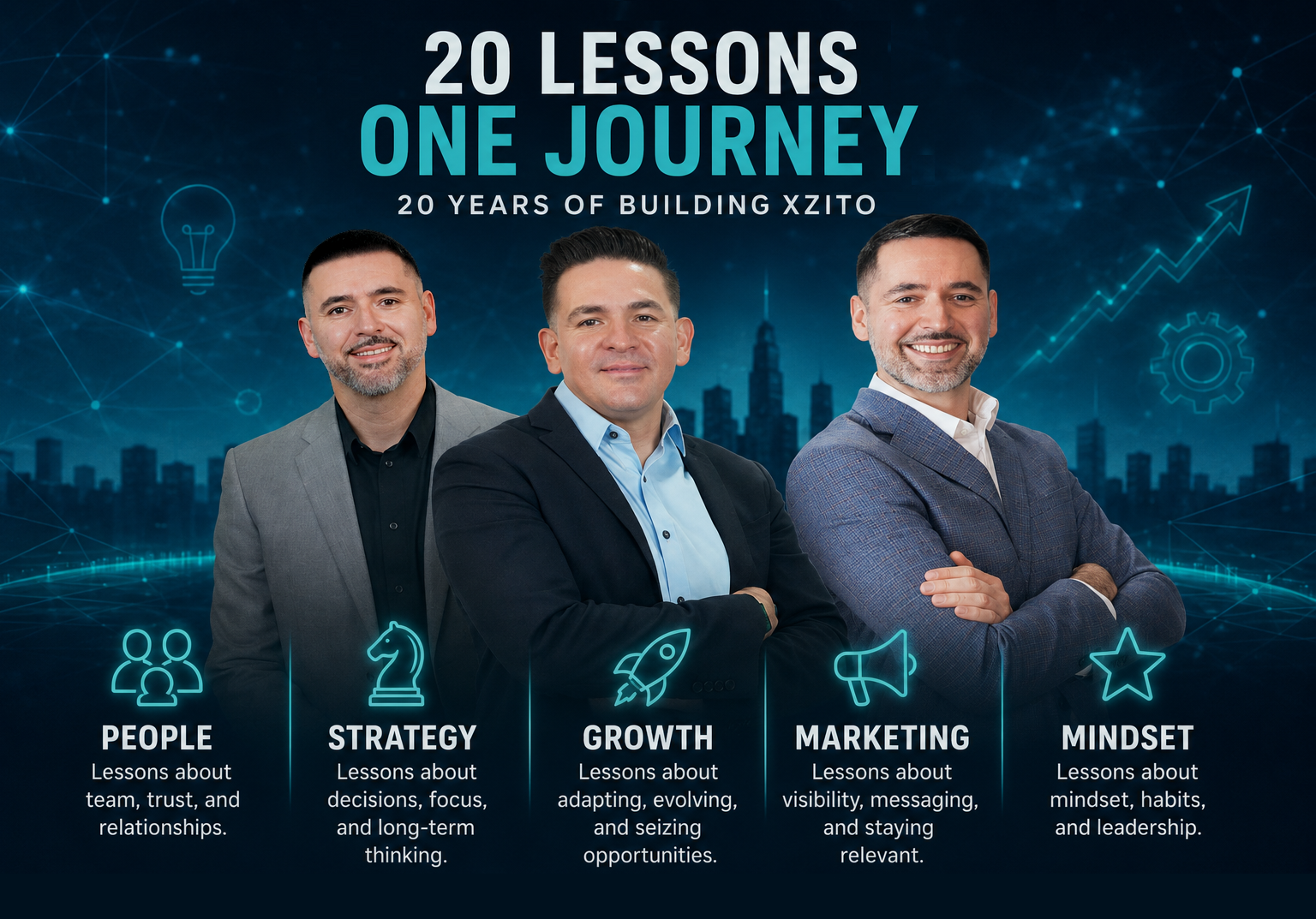
Twenty years ago, we started knocking on doors. Jeshua sold. Juan built websites. Jairo designed marketing materials. None of us knew whether the business would last a year. We didn't have investors or a roadmap, just jobs during the day, clients at night, and a belief that if we kept showing up, opportunities would eventually follow.
Two decades later, we're still showing up. A lot has changed since then. Back when we started, convincing a business owner to invest in a website was a challenge. Today, companies are trying to figure out how AI will reshape marketing, sales, and customer experience. The tools, questions and pace have changed. What hasn't changed are the lessons behind sustainable growth.
The lessons that follow were earned through client conversations, hard decisions, unexpected opportunities, and a lot of trial and error.
Some may apply to your business today. Others may help you see a challenge differently. Either way, these are the lessons twenty years of building Xzito taught us about growth.
Lessons in Taking the Leap

1. There's no guarantee, and that's the point
At the age of 23, the three of us had a choice. Stay in stable corporate jobs or bet on a business that had no investors, no roadmap, and no guarantee of working. Juan's reflection today: there's no guarantee in anything in life, and knowing that, is what frees you to take the leap. Now at 43, with mortgages, kids, and obligations, making the same call would be almost impossible. The discomfort of starting young is what created the runway for everything that followed.
The lesson: Waiting for certainty is the most common reason businesses never get started. The leap is harder later, not easier. Start before the conditions feel perfect.
2. De-risk the leap, don't avoid it
For two years, we worked corporate jobs by day and built Xzito at night. When we finally went full-time, we staggered it. Jairo went first because he earned the least, then Jeshua, then Juan. If one of us stumbled, the other two were still earning. This staggered approach is what carried us through the stage where most businesses don't survive.
The lesson: Bold doesn't have to mean taking a reckless leap. The biggest risks can almost always be broken into smaller steps: going full-time in stages, testing a side project, soft-launching before you commit. Cut the risk. Keep the bet.
3. Strategic pauses create results
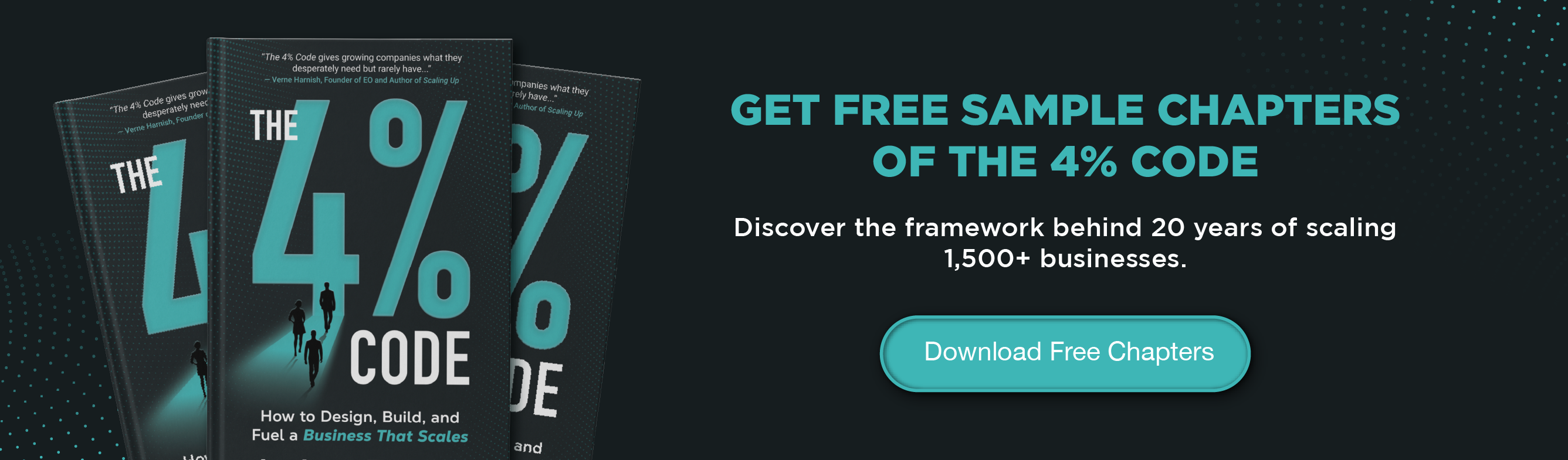
A few years ago, the three of us sat down for one of our quarterly planning sessions. We asked ourselves a simple question: how do we impact more people? Out of that single conversation came The 4% Code book, our training programs, and the speaking schedule that's now part of how Xzito grows. A few hours of reflection produced years of compounding outcomes.
The lesson: Planning isn't the enemy of execution, but living in plan mode is. Set rituals to step back, reflect, and decide what's next. Then spend the rest of your time building.
4. Growth lives on the other side of discomfort
When Jairo went full-time, his first job was selling himself at 7 a.m. BNI breakfasts. Walking into a room of strangers, explaining what we did, and asking for leads. He wasn't a natural seller. He forced himself through the discomfort week after week, and that's how the first wave of clients came in.
The lesson: The skills that scale a business often sit just past the edge of what feels natural, selling when you're not a seller, leading when you're not yet a leader. Pushing through that discomfort is how the next version of the business gets built.
Lessons in Market Selection

5. Willingness to pay decides everything
Early on, we worked with smaller businesses that didn't yet see the value of a website. Even when they did, many couldn't or wouldn't pay for it. The shift came when we started serving medium and larger companies that saw a website as a business investment, not an expense. Nothing about our service changed. What changed was who we were selling it to.
The lesson: The market that needs you and the market that will pay you aren't always the same. Until you find customers who both need the solution and are willing to invest in it, growth will always feel harder than it should.
6. The Best Clients Aren't Defined by Industry. They're Defined by Mindset
Once we found a market that would pay, the next refinement took years. The clients we did our best work with came from different industries, different company sizes, and different parts of the country. What they shared wasn't a demographic profile. It was a way of thinking.
They were curious. They were willing to challenge assumptions. They weren't attached to doing things the way they'd always been done. When the market changed, they adapted instead of defending the status quo.
Over time, we realized those traits mattered more than industry, revenue, or geography. The right mindset consistently produced better partnerships and better results.
The lesson: Industry and company size can help you narrow your focus, but they rarely tell you who your best customers will be. The clients worth pursuing are the ones willing to learn, adapt, and grow alongside you.
7. Don't Build Your Business on One Client
For years, we worked with a client we genuinely loved. The work was meaningful, the relationship was strong, and our role kept expanding. What started as a great partnership slowly became a dependency. Without anyone paying close attention, that one client eventually represented nearly half of our revenue.
Then they were acquired. Within weeks, the parent company's internal team absorbed most of the work we'd been doing. We went from feeling secure to scrambling to replace revenue we had assumed would always be there.
The acquisition wasn't the problem. The problem was allowing one client to become so important that their decisions could reshape our future overnight..
The lesson: Growth can create risks that don't feel like risks until they're exposed. No matter how strong the relationship feels, no single client should represent more than 20% of your revenue. Diversification isn't just a growth strategy. It's protection against changes you can't control.
8. Read the market and have the courage to pivot
Xzito didn't start as a marketing agency. We started as a design shop: websites, branding, print. Around year three or four, we kept hearing the same thing from clients: design alone wasn't enough. They needed SEO, advertising, strategy and automation. We had to decide whether to stay in the lane we were good in, or rebuild the company to meet where the market was going. We decided to rebuild.
The lesson: The plan that got you to where you are now, often isn't the one that gets your business to the next stage. Reading the market and being willing to adapt is how you grow over time.
Lessons in Client Relationships

9. The Word "We" Changes the Relationship
A few years into building Xzito, Juan was on a call with a client when she stopped him mid-sentence.
He'd been saying things like, "We should test that," and "We need to figure this out," instead of talking about "you" and "your team."
She paused and said, "I like that. You're not separating yourself from us."
Juan hadn't done it intentionally. He was simply thinking about the client's challenges as if they were his own. But her comment revealed something important: the language we use shapes how clients experience the relationship.
From that point forward, "we" became a conscious choice. Not because it sounded better, but because it reflected how we wanted to show up, as a partner invested in the outcome, not a vendor completing a task.
The lesson: Language signals positioning. When clients feel like you're working alongside them instead of working for them, the relationship changes. Partners get invited into conversations, decisions, and opportunities that vendors never see.
10. Trust is earned through small wins, not big promises
Even though no one knew us in Xzito's early years, a marketing manager at Teknor Apex decided to give us a chance. Her words were simple: "I'll give you a shot."
It started with one small project. No long-term contract. No big commitment. Just an opportunity to prove ourselves. The work did what the pitch couldn't. One project became three. Three became an ongoing partnership that has now spanned more than fifteen years.
Looking back, many of our strongest client relationships started the same way: a small opportunity, a delivered result, and trust that grew over time.
The lesson: Big clients rarely start big. Earn the first project. Deliver it well. Then let the work build the trust that no pitch ever could.
11. Come to clients with ideas, not just questions
Over the years, we've noticed a pattern. The agencies that get replaced tend to wait for direction. The agencies that become trusted partners bring ideas to the table.
As Jeshua puts it: "We don't come in with a bunch of questions. We come in with questions plus ideas."
Clients don't need another vendor showing up empty-handed. They need someone who's paying attention, thinking ahead, and willing to offer a point of view. That's what turns a service relationship into a partnership.
The lesson: Reactivity may keep a client. Proactivity earns trust. Bring ideas to every conversation, even when no one asks for them.
12. Referrals Are a Gift, Never a Growth Plan
For years, referrals were the biggest source of new business for Xzito. They came with built-in trust, stronger relationships, and far less resistance than any marketing campaign we could run.
The problem wasn't that referrals didn't work. The problem was that we didn't control them.
Referrals depend on other people remembering you, talking about you, and having opportunities to send business your way. Some years, they flow naturally. Other years, they slow down for reasons that have nothing to do with the quality of your work.
Eventually, we realized that referrals are most valuable when they're a supplement to your growth engine, not the engine itself.
The lesson: Referrals are one of the best ways to grow a business, but they're not a strategy you control. Build a marketing engine that consistently creates opportunities, even when referrals are flowing. The businesses that scale don't rely on hope. They create demand.
Lessons in Partnership

13. Strong Partnerships Put the Company First
Twenty years with the same two partners doesn't happen by accident. As Jairo puts it, "It's like a marriage. There's never going to be anything perfect."
What kept us together wasn't constant agreement. We disagreed often. We brought different personalities, instincts, and opinions to the table. But when the decisions got hard, we kept coming back to the same question: what's best for the company?
That question forced us to put ego aside, listen when we didn't want to, and choose the business over personal preference.
The lesson: There's no such thing as a perfect partnership. There are only partners willing to keep choosing the work over their own ego. For us, that's what allowed three very different people to build something together for twenty years.
14. Your Strengths Can Become Your Blind Spots
Over twenty years, we've learned to appreciate each other's strengths and challenge each other's weaknesses without taking it personally.
What made that important is that the traits that help leaders succeed can also create problems when taken too far. The willingness to say yes can lead to overcommitment. The persistence that gets you through tough times can keep you holding onto an idea that's no longer working. The attention to detail that protects quality can slow down execution.
Learning to spot those blind spots in each other became one of the most valuable parts of our partnership.
The lesson: Every strength has a shadow side. The people closest to your work should be able to challenge your thinking, not just support it. Honest feedback isn't criticism. It's protection against blind spots that can become costly mistakes.
15. Define your values through behaviors, not posters
About eight years into the business, we brought in leadership coach Jeff Deckman to help us define our company values.
He didn't walk in with a template or a list of words for us to choose from. Instead, he asked the team two simple questions:
What behaviors frustrate you? What behaviors excite you?
The answers revealed far more than any strategy session could. As people shared stories and experiences, patterns started to emerge. The values that define Xzito today didn't come from a conference room exercise. They came from the behaviors our team already respected, expected, and rewarded.
That's why those values have lasted. They weren't invented. They were discovered.
The lesson: Culture isn't built by writing values on a wall. It's built by the behaviors you recognize, reward, and reinforce every day. The strongest values aren't the ones you choose. They're the ones your team is already living.
16. Stop being the only voice for your business
For years, Jeshua delivered every Xzito workshop himself. He believed only he could communicate the mission the right way. When a new hire, Alejandro, took over the presentation, the room responded better. The mission wasn't trapped inside the founder, it was already in the people doing the work. Letting Alejandro carry it freed Jeshua to build the next thing.
The lesson: Founders often become the bottleneck on their own message. When the team is aligned and proud, they multiply the message in ways no founder can do alone. Step out of the way.
Lessons in Staying Relevant & Scaling

17. Curiosity is the engine behind every adaptation
As a teenager, Juan got his first computer from his aunt. Eager to make it faster, he tried upgrading the memory himself. He broke it.
With no money to replace it, he had one option: figure it out. So he spent weeks reading articles, digging through forums, and teaching himself how to fix it. This was long before YouTube tutorials made everything easier.
That experience taught him a habit that's shaped Xzito ever since: when you don't know something, learn it.
Over the years, that mindset carried us through every major shift. We started in design, moved into web development, expanded into digital marketing, and today help companies navigate AI-driven growth. Every transition began the same way: with a willingness to learn something we didn't yet understand.
The lesson: Curiosity isn't just a personality trait. It's a discipline. The leaders who keep learning are the ones most prepared to adapt. And the businesses that adapt are the ones that keep growing.
18. Build for Where the Market Is Going, Not Where It Is
Twenty years ago, one of our biggest sales challenges was convincing business owners they needed a website.
Many didn't see the value. Some thought it was a passing trend. Others preferred to wait until they were sure it mattered. Today, we're hearing many of the same conversations about AI.
The technology has changed, but the pattern hasn't. Every major shift creates uncertainty. Some businesses wait until the change is impossible to ignore. Others lean in early, learn faster, and gain an advantage while everyone else is still deciding what to do.
We've seen it with websites. We've seen it with social media. We've seen it with mobile. And now we're seeing it with AI.
The lesson: Most customers can't clearly articulate what they'll need next because they're still focused on today's challenges. Part of leadership is looking around the corner. Pay attention to where the market is heading, and start building before the demand becomes obvious.
19. Marketing Is an Engine, Not a Faucet
Before Xzito existed, Jairo worked in advertising at a newspaper called Providence en Español. Every week, business owners came to him with the same question: “How do I get my message in front of the right people?”
Back then, the channels were newspapers, radio, and billboards. Today, they are Google, social media, and AI search. The tools have changed, but the question has not.
The mistake businesses make has not changed either. They turn marketing on when business slows down, turn it off when things pick up, and then wonder why growth feels inconsistent..
The lesson: People still need to know you exist before they can buy from you. Marketing works best when it runs consistently, not when it gets switched on only when sales are slow. Treat it like an engine you maintain year-round, not a faucet you open when you need more leads.
20. Pick a direction. If it doesn't work, reinvent
At a college concert, Juan and Jeshua heard an artist, Busta Rhymes, pause between songs and told the crowd: "Pick a direction. If it doesn't work, reinvent yourself. You can always pivot , that's the beauty of life." Twenty years later, that line still describes how Xzito operates. First we started as a design shop. Then we became a full service marketing agency, and now where becoming an AI-powered marketing agency. The destination changed three or four times along the way. The willingness to keep moving never did.
The lesson: Reinvention isn't failure, it's the price of staying in business for twenty years. Pick a direction. Move. If the direction stops working, pick a new one. Repeat for as long as you want to be around.
The Lessons Beneath the Lessons
Twenty years of building Xzito hasn't been a straight line of wins. It's been a series of decisions, mistakes, pivots, opportunities, and lessons that slowly compounded over time.
Looking back, the biggest breakthroughs rarely came from having all the answers. They came from being willing to take the next step before we felt ready, adapt when the market changed, learn what we didn't know, and keep moving when the outcome wasn't guaranteed.
That's what growth has looked like for us. Not certainty. Not perfection. Just a commitment to keep learning, keep adapting, and keep showing up.
The tools will change. The market will change. The next twenty years will look different than the last twenty.
But one thing won't. Never stop knocking.
Want the Playbook Behind the Lessons?
Download sample chapters of The 4% Code to learn how to design, build, fuel, and scale your business, from the same frameworks Xzito has used for two decades.